Regular Code, Machine Learning, or LLMs: A Business Guide
I saw a technical critic argue that LLMs are basically useless for business.
I do not agree with that.
But I do understand where the frustration comes from. A lot of companies are reaching for LLMs when they should be using traditional machine learning, and some are reaching for AI when they should be writing normal deterministic code.
My issue is not with LLMs. It is with making them the default architecture.
They should not be.
Start With The Problem, Not The Technology
Before a business asks "should we use AI?", it should ask a simpler question:
What kind of problem is this?
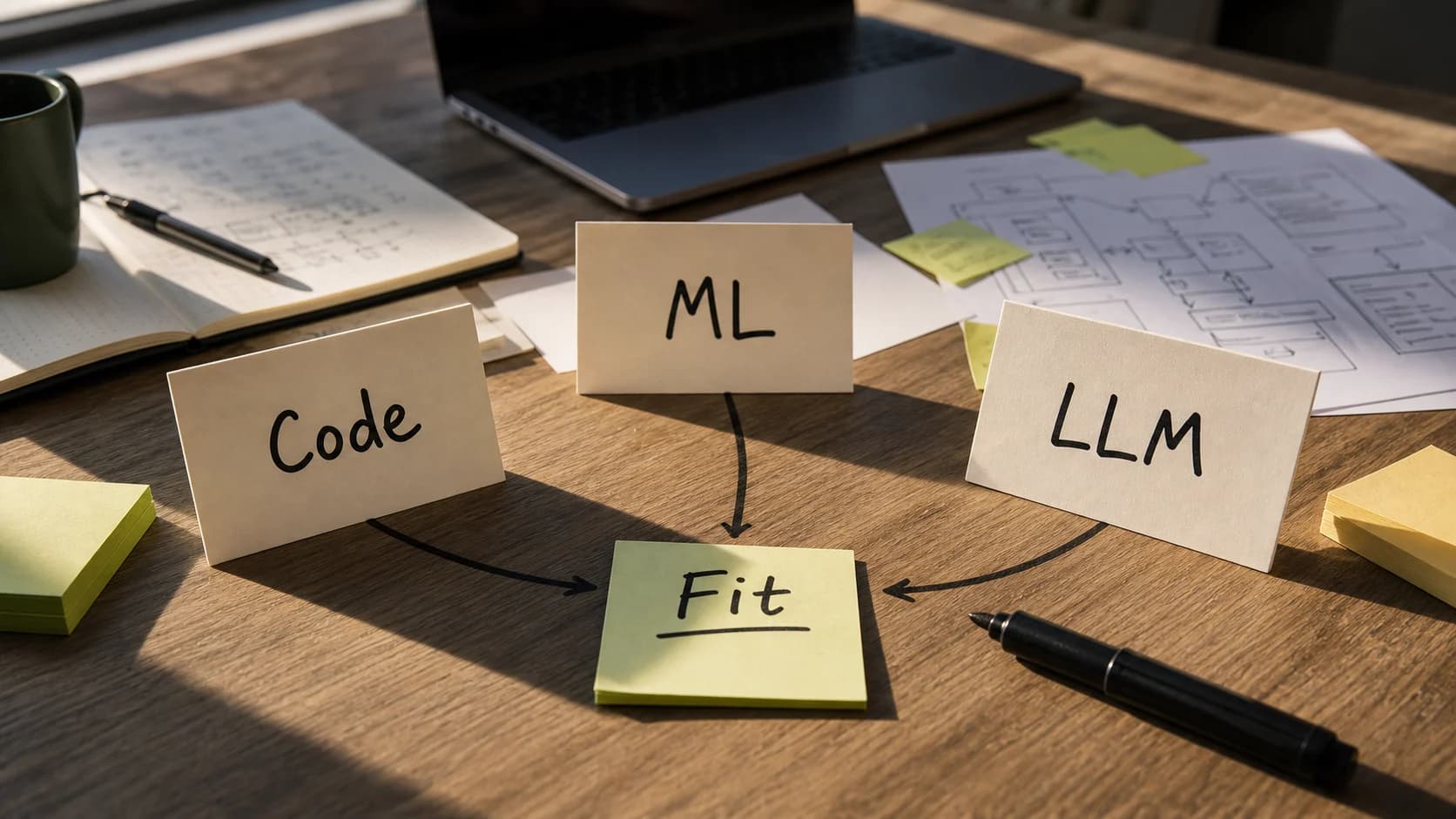
One terminology note: LLMs are machine learning systems. In this article, I am separating "traditional machine learning" from LLMs because most business decisions are really choosing between deterministic software, predictive models, and generative language models.
Rules? Use code.
Patterns in historical data? Use traditional machine learning.
Messy language, documents, or conversation? Now an LLM belongs in the conversation.
Those are different categories. Blending them together is how companies end up paying LLM prices for problems a simple function could solve.
Use Regular Code When The Rules Are Clear
This is the category companies skip because it does not look like innovation.
If the business rule is known, stable, and explainable, write code.
Examples:
- Apply a discount when a customer has a certain plan.
- Route a support ticket based on a selected category.
- Retry an API call after a
503response. - Calculate tax, fees, or eligibility from known fields.
- Block a transaction that violates a fixed policy.
You do not need an LLM for that. You probably do not need traditional ML either.
Google Cloud's guidance makes the same basic distinction: use traditional AI for prediction or classification, and use generative AI when the task needs new text, images, code, or other generated output. That advice sounds boring until it saves you from putting a language model in the middle of a billing rule.
Regular code has advantages businesses sometimes undervalue. It is cheaper. It is faster. It is easier to test. It is easier to explain to auditors. It behaves the same way every time.
If consistency matters more than interpretation, code should be the first option.
Use Traditional Machine Learning When Patterns Matter
Traditional machine learning fits a different class of problem.
Use ML when you have historical data and you want the system to learn a pattern that is hard to express as rules.
Examples:
- Predict customer churn.
- Detect fraud or anomaly patterns.
- Forecast demand.
- Score credit risk.
- Classify support tickets from past examples.
- Recommend products based on behavior.
These are not problems where you want the system to "write an answer." You want it to estimate, rank, classify, or forecast.
Google Cloud makes a similar distinction: traditional AI use cases usually focus on predicting outcomes or classifying categories based on models trained on historical data. Microsoft also separates predictive AI from generative AI: predictive AI forecasts outcomes, while generative AI produces new content like text, code, images, and other outputs.
That distinction matters because a lot of business AI use cases are not actually generative.
If a company wants to know which customers are likely to cancel next month, an LLM is probably not the core model. It might help explain the result or draft a retention message, but the prediction itself belongs to a model designed for prediction.
Use LLMs When Language, Context, Or Flexibility Matter
LLMs become valuable when the input or output is messy, language-heavy, and context-dependent.
Examples:
- Summarizing long customer conversations.
- Drafting responses that still need human review.
- Extracting structured fields from messy documents.
- Explaining technical logs in plain language.
- Searching internal knowledge bases with natural language.
- Generating first drafts of reports, emails, or documentation.
- Helping employees reason across multiple documents.
This is where LLMs earn their keep: not by being correct databases, but by helping people read, rewrite, compare, and explain messy material faster.
The mistake is using them where their flexibility becomes a liability.
Even for language work, I would be careful. If the format is stable, extraction rules are clear, latency is tight, data is sensitive, auditability matters, or the output cannot tolerate hallucination, do not default to an LLM. Use the model only where flexible interpretation is worth the extra cost and risk.
If a deterministic system needs to decide whether an invoice is overdue, use code.
If a model needs to predict the probability of late payment based on years of invoices, use traditional ML.
If a system needs to summarize the messy email thread around that invoice and draft a polite follow-up, use an LLM.
That is three different jobs.
When A Hybrid Approach Makes Sense
The cleanest answer is not always one tool.
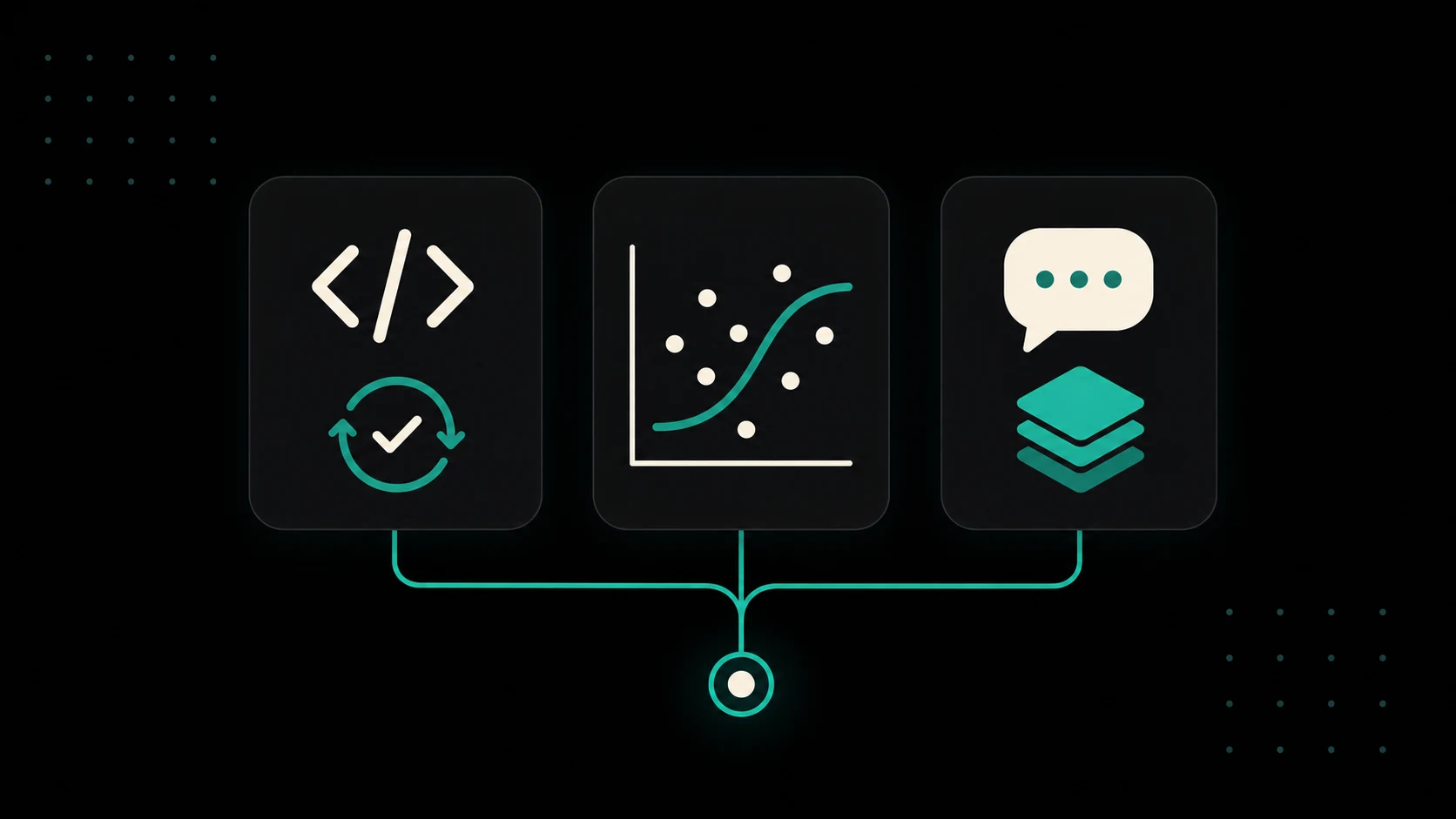
In real business systems, the best architecture often combines code, ML, and LLMs.
Imagine a customer support workflow.
Regular code can enforce permissions, routing rules, SLA timers, and escalation thresholds.
Traditional ML can predict ticket priority or detect likely churn.
An LLM can summarize the customer history, draft a response, or explain the next best action to the support agent.
Each layer does what it is good at. The LLM is not asked to own the whole system. The ML model is not asked to write human-friendly explanations. The code is not stretched into pattern recognition it cannot handle.
Google Cloud's guidance says traditional AI and generative AI are not mutually exclusive, and it gives examples where predictive models feed context into generative systems. That is the more mature way to think about AI architecture.
A Simple Decision Checklist
Before using an LLM, I would ask five questions:
| Question | Best fit |
|---|---|
| Can the rule be written clearly? | Regular code |
| Is the job prediction, ranking, or classification? | Traditional ML |
| Is the input messy language or documents? | LLM |
| Does the output need to be generated text? | LLM |
| Does the decision need to be deterministic and auditable? | Regular code or ML with controls |
This is not about being anti-LLM. It is about putting the expensive, flexible, probabilistic part of the system where flexibility is actually useful.
The Practical Takeaway
The PhD argument is useful because it pushes back against lazy AI architecture.
He is right that many business use cases do not need LLMs. Some do not need machine learning at all. They need clean workflows, reliable data, and normal software engineering.
But "LLMs are useless" goes too far.
LLMs are useful when the work is language-heavy, context-heavy, and hard to reduce to fixed rules. They are less useful when a business needs deterministic logic, cheap repeatability, or a narrow predictive model.
Stop asking whether the system is "AI." Ask whether each decision needs rules, statistics, or language judgment. That question saves more money than another model evaluation.
Sources: Google Cloud on generative AI vs traditional AI, Microsoft on generative AI vs predictive AI, and IBM on generative AI limitations.
Tagged